





 By
By 
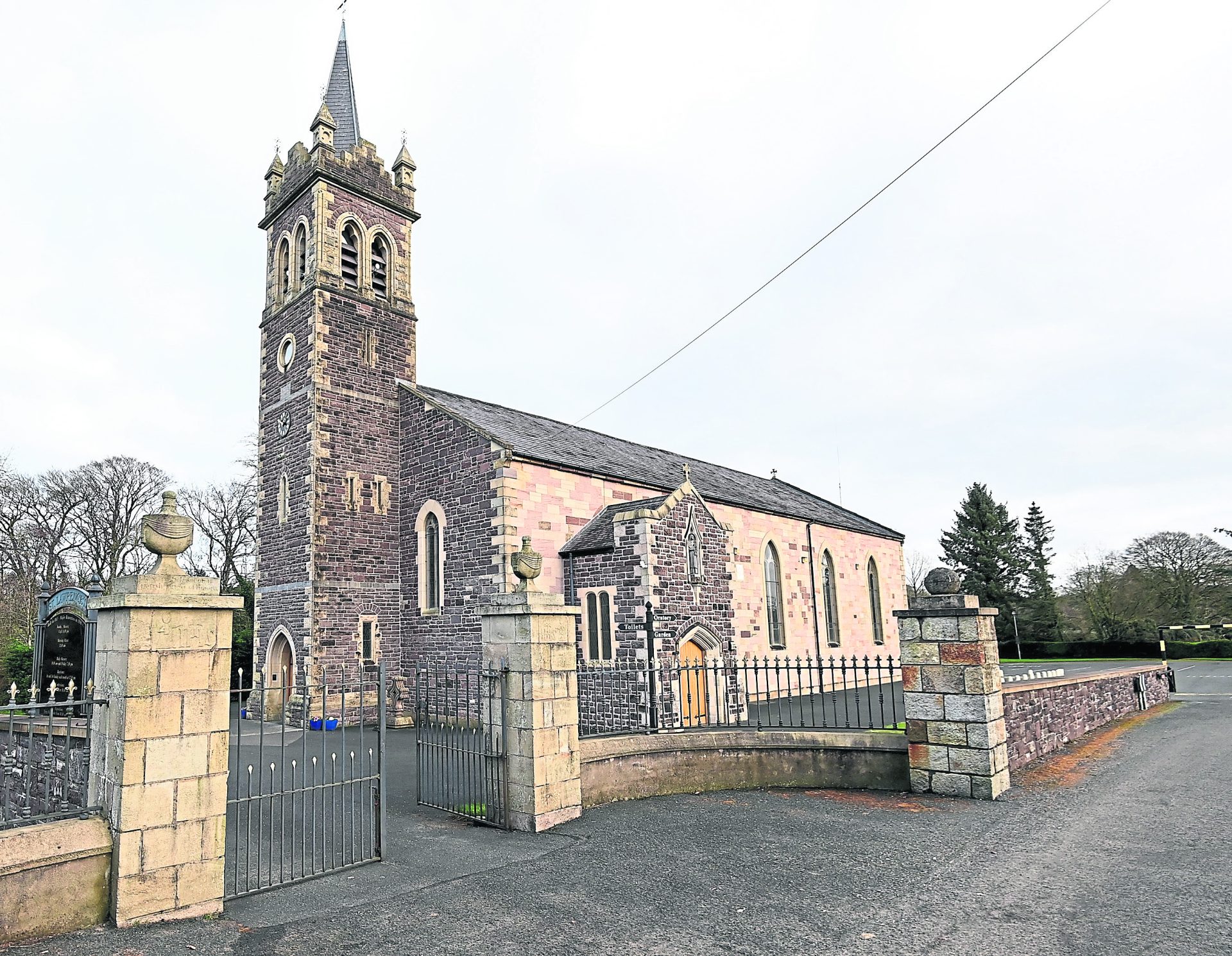
STANDING on the outskirts of Fintona is St Lawrence’s Church, a place of worship dedicated to a noble martyr and steeped in centuries of local faith and history.
With its symmetrical frontage welcoming parishioners to the familiar red-and-yellow building, the church carries a story far older than its stone walls suggest.
While St Lawrence’s Church was constructed in 1841, it was not the first place of worship on the site.
The parish of Fintona, Donacavey, derives its name from the area’s earliest church, believed to have been founded by St Patrick himself, who is said to have built the first church in the diocese.
All that remains from those early Christian beginnings are ruins and an adjoining disused cemetery.
For many years afterwards, little is recorded until the post-Reformation period.
The next documented reference appears in the Popery Report of 1731, which mentions the existence of a masshouse prior to the reign of George I, which began in 1714.
Interestingly, this suggests not only the construction of a Catholic place of worship during the penal laws – when Catholicism was heavily restricted – but also that parishioners were openly practising their faith.
While secret worship at mass rocks was common during that era, the presence of a dedicated Catholic church was far more unusual.
More than a century later, the church we know today was built.
Designed as a detached, double-height Gothic Revival Roman Catholic church, it was completed in 1841.
The building comprises a rectangular nave with a chancel to the east, a gabled porch to the south (added in 1925), and a square tower to the west. Its gothic leaded stained-glass windows are set within stepped sandstone surrounds.
Measuring 115 feet long by 51 feet eight inches wide, it is possibly the largest church of its type in the Diocese of Clogher. The roof is supported by massive memel tie beams, drawn by parishioners from the port of Ballyshannon and still sound today. A tablet on the church front reads: ‘Erected by Rev J Kelly, PP, Fintona 1841’.
The church is named after St Lawrence, a third-century Roman deacon and Christian martyr who was entrusted with caring for the Church’s possessions and distributing aid to the poor.
According to tradition, when he was ordered by Roman authorities to hand over the Church’s riches, he presented the poor and vulnerable instead, declaring them to be its true treasure.
His defiance enraged the Roman prefect, and Lawrence was executed for his faith, becoming one of the most revered martyrs of the early Christian Church.
In the years following its construction, St Lawrence’s underwent several significant renovations. In 1872, Canon Cassidy erected the present tower and spire.
Forty-five years later, a major renovation and extension programme was carried out under Canon Maguire, based on designs by Professor R M Butler, at a cost of £8,000. This included new sacristies, a porch added in 1925, and a marble baptistry.
Further changes followed in 1996, when the sanctuary was reorganised and the church extended to include ancillary rooms and a chapel for morning Mass, dedicated to Our Lady.
The most recent major works took place in 2013, when Woodvale Construction carried out extensive restoration, including renewal of the spire, refurbishment of the bell, stone repairs, leadwork, glazing restoration and internal redecoration, all while allowing worship to continue.
Today, St Lawrence’s Church continues to serve as the parish church of Fintona, hosting daily worship, weddings and funerals, and remaining central to community life.