





 By
By 
GRAY’S Stationery Shop and Printing Press was once one of Strabane’s best-known businesses, and enduring folklore links it to the early story of the United States.
Though its machines have long fallen silent, the press – and the building that housed it – remains an important part of Strabane’s industrial and cultural heritage.
The origins of the press are the subject of debate. An inscription above the doorway once claimed it was established in 1760, yet on expert suggests printing did not begin in Strabane until at least a decade later.
Others note that no machinery was officially registered to the owner until the early 19th century.
The first firm reference to the business appears in the 1833 Ordnance Survey map, where it is listed as a ‘house, printing offices and yard’ leased from Catherine E Cowan and occupied by John Gray.
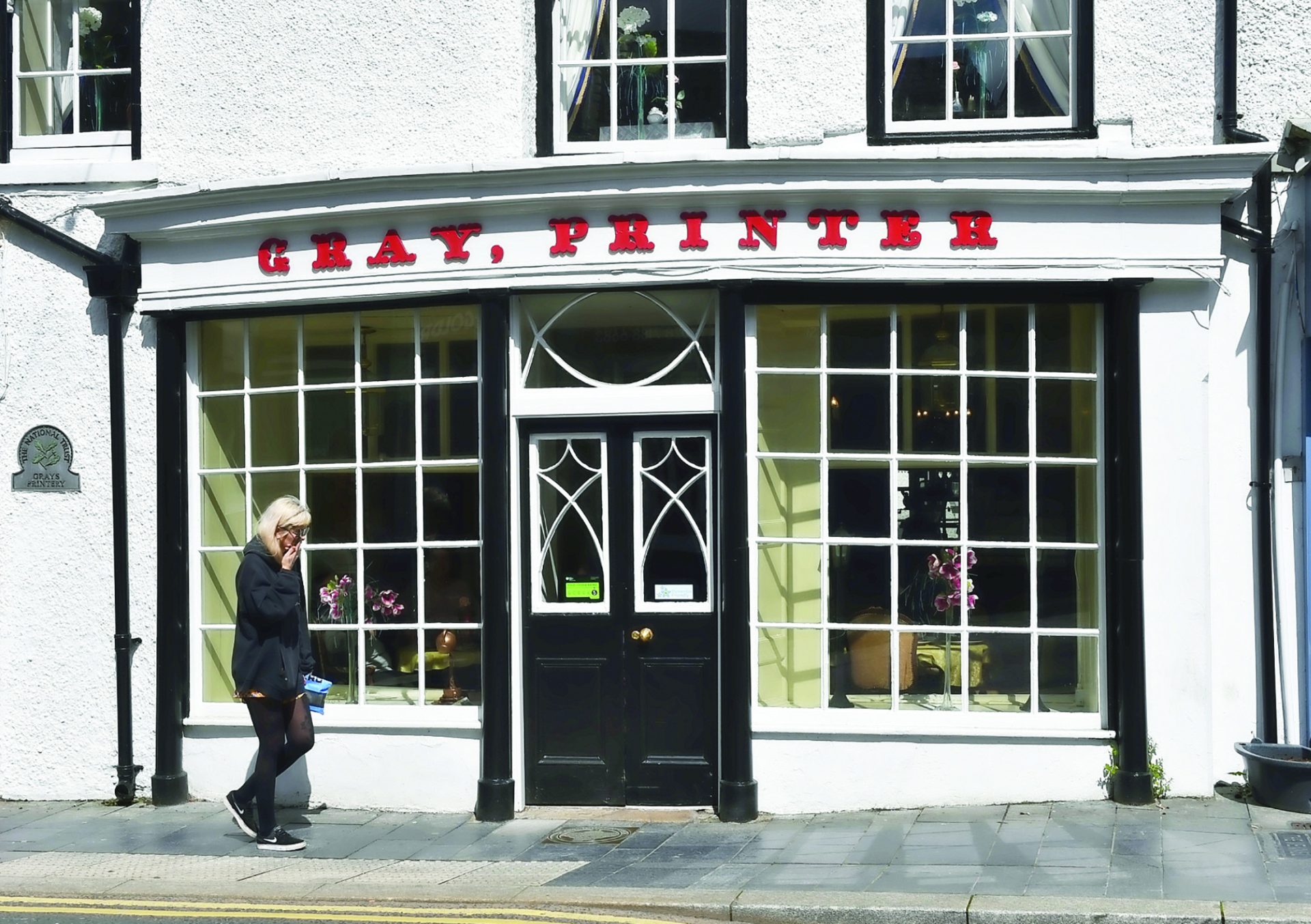
Architectural historian Dr Seán Rothery described the shopfront as ‘one of the oldest surviving traditional shopfronts in Ireland’, dating from the late 18th century. Its curved Georgian façade, timber cornice, nameboard and many-paned bow windows were typical of the era.
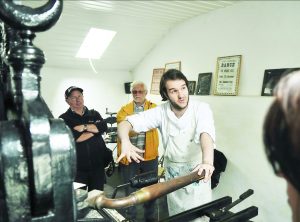
Inside, the operation was just as impressive. Gray’s housed a collection of sophisticated European and American presses. Among them were a Columbian Press, an Albion Press and three Platen Presses – machines invented between 1813 and 1856 that were used commercially well into the 20th century.
When the National Trust acquired the building after its closure in 1968, its inventory included not only the historic presses but a hand-operated guillotine, perforator, stapling machine, lead cutter and extensive supplies of wooden and metal type. Some of the typefaces – Pica, Brevier and Long Primer – pre-dated the adoption of the modern point system in 1886.
Gray’s also carries intriguing, if disputed, connections to the United States.
Local tradition claims that John Dunlap, the Strabane-born printer who produced the first daily newspaper in the US and famously printed the Declaration of Independence in 1776, served his apprenticeship at the press. Dunlap emigrated to Philadelphia in 1756 at the age of ten, however no firm evidence exists to confirm he worked at Gray’s, which was unlikely to have been established by then.
It is also said that James Wilson – grandfather of future US President Woodrow Wilson – apprenticed there, though this too remains unproven. True or not, these stories have long added romance to the site’s history and helped attract American visitors.
In 1997, following extensive restoration, the National Trust reopened Gray’s Printing Press as a museum.
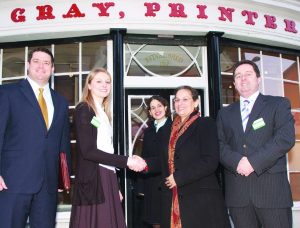
The ceremony was attended by US ambassador Jean Kennedy Smith, who formally unveiled the site in recognition of its celebrated – and alleged – American links.
President Bill Clinton later sent a letter acknowledging the importance of preserving the building’s heritage.
Since then, the museum has welcomed a steady stream of visitors, including many from the United States, eager to see the presses and workshop that may – or may not – have played a part in shaping their nation’s early printed history.