





 By
By 
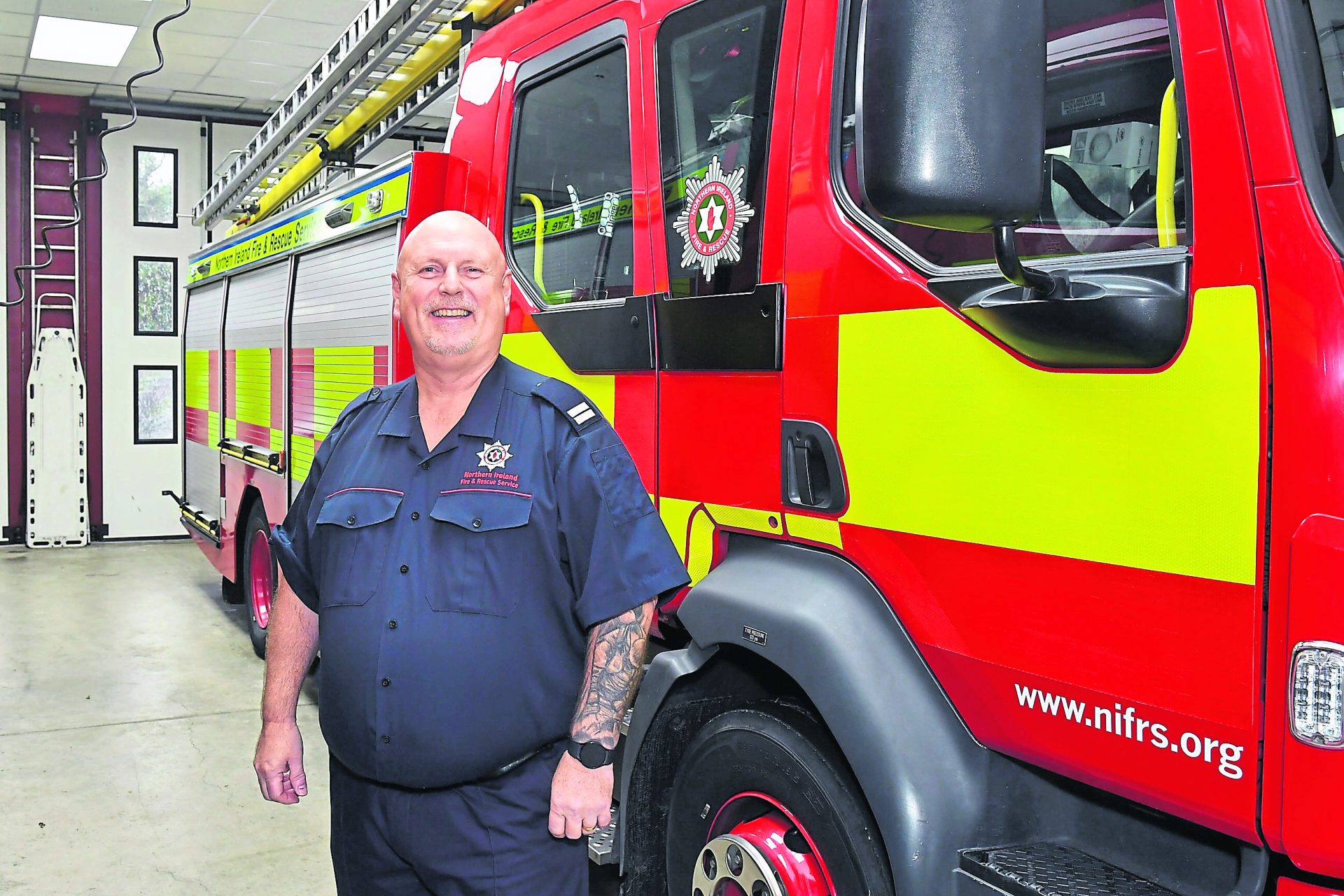
WHEN Castlederg man Ralph Lyons attended a recruitment day with the Northern Ireland Fire and Rescue Service (NIFRS) in 1987, he had no idea how profoundly it would shape his life.
Joining the service at just 20, Mr Lyons worked his way up the ranks -becoming Crew Commander in 2000 and later Watch Commander in 2016.
Although he continues to work as a Logistics Support Technician, he has now retired from operational duties and has been reflecting on nearly four decades of service, from working through the Troubles to stepping aside for what he calls ‘the next generation who will carry the good name of Castlederg Fire Station forward’.
“I joined the service on November 5, 1987 – Guy Fawkes night!” he recalled.
Before then, Ralph had left school at 16 and worked as a mechanic in his late father’s business, Lyons Brothers Garage in Castlederg.
It was a colleague, Jackie Reid – also a firefighter – who encouraged him to consider joining the service.
“I wasn’t overly interested at the time,” he admitted. “But I went along to the recruitment day to see what it was about. Before I knew it, I had been accepted along with five others.”
His first call-out involved a workshop fire on the Folliard Road near Castlederg.
Soon he was dealing with the usual mix of chimney, skip and car fires.
But it wasn’t long before Ralph encountered something he would never forget – his first fatality.
“It was after a collision near Newtownstewart Golf Club,” he said. “I remember being the only recruit on the appliance with experienced personnel. It was horrific.
“I offered to stand back and sort the equipment, but the person was declared deceased at the scene and I had to get stuck in.”
The experience was, he said, ‘a big stepping stone’ in his career.
“You never forget your first fatality… or any of them, really. Some you don’t want to remember, but you have no choice.”
Beginning his career during the Troubles brought its own dangers.
“We were often first on the scene alongside the RUC, waiting for the army to arrive,” he said.
“Sometimes we were there in case an explosion occurred; other times a bomb had already detonated and we had to tackle the flames and deal with the aftermath.
“Those incidents were approached with extreme caution – you weren’t rushing into anything.”
As the conflict eased from the mid-1990s, the service returned to more routine call-outs, though every year brought what Ralph called ‘gorse season’- January to Easter.
“This year was particularly bad with major incidents across the county,” he said. “You could be battling fires for six to eight hours before being relieved, only to be called back again a few hours later.”
Ralph became Crew Commander in 2000, taking responsibility for managing and training a crew of five.
“On drill nights we put the crews through their paces, making sure they were ready for whatever they might face.”
In August 2016 he was promoted to Watch Commander, overseeing training and producing detailed reports after incidents.
But after nearly 38 years on the frontline, Ralph felt it was time to retire.
“I’m coming up on 60,” he said. “Ideally, I’d have liked to make it to 40 years of service, but looking back I thought, ‘I’ve done my time.’ The fire service is a younger man’s game today.”
Looking back on the length and breadth of his career, Ralph concluded, “I’ve thoroughly enjoyed my 38 years in the service, and I’m very proud of what I’ve achieved.”