





 By
By 
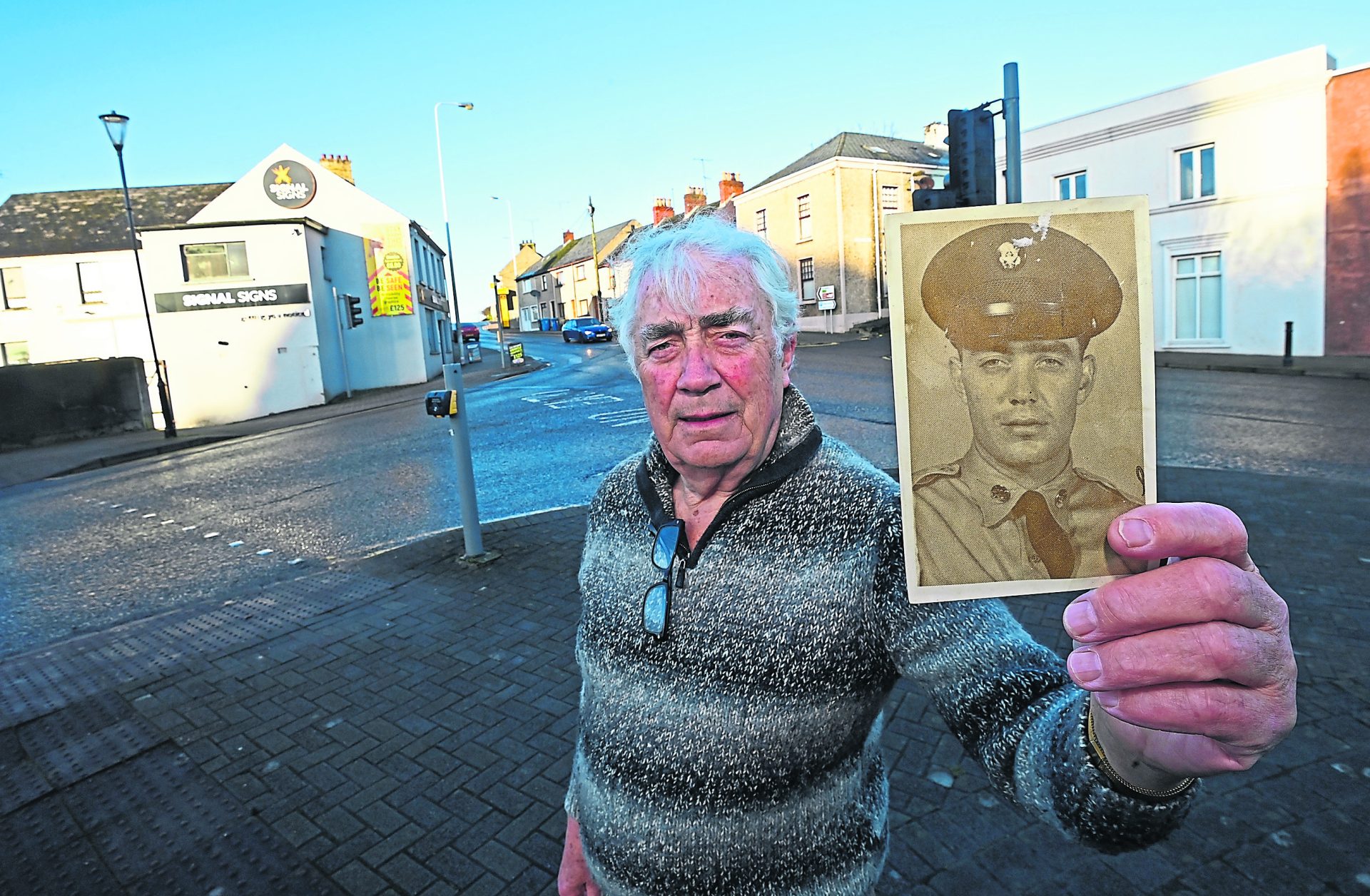
EVERYONE keeps something from their parents at one time or another. In Jim McBride’s case, it wasn’t a failed exam or getting into a bit of trouble at school, but the small matter of being drafted into the US Army and sent to Vietnam.
Most people picture the Vietnam War through the influence of movie classics such as Platoon, Full Metal Jacket and Apocalypse Now – tough bootcamps, jungle ambushes, choppers skimming treetops. So the idea of an Omagh man caught in the middle of one of the most defining conflicts of the 20th century feels almost surreal. Yet that is exactly the path life carved out for the former CBS pupil back in the mid-1960s.
When Jim recently walked into the ‘Herald office wearing a quilted body-warmer reminiscent of a GI flak jacket, he didn’t ease into conversation.
“Callum,” he said, in his half-American, half-Tyrone accent, “I’m a man of action, so I’m going to tell you how Vietnam was.”
Jim grew up in the Abbey Street area of Omagh
“Born there, raised there, I spent 21 years of my life there,” he said.
He walked to the old Christian Brothers school beside the parochial hall – 200 yards, every day, for 12 years.
“I did alright at school,” Jim added. “I coasted along.”
After leaving school, Jim went to work for his father, who ran a grocery shop and small bakery. He helped with deliveries and kept the place going.
His cousin Eamon from Leitrim lived with them during that time, working for Jim’s father before eventually emigrating to the United States.
“His mother was talking to mine and encouraged me to go too,” Jim said. “I suppose her thinking was: What was here for me? A young Catholic in Northern Ireland in the early ’60s.”
Moving to America came with one major condition – Jim had to sign up for Selective Service, better known as the draft.
In the 1960s, every eligible young man in the United States was required to register.
After emigrating, Jim settled in Manhattan, New York, where he was living and working when he was called up.
Jim was drafted under a local board system: Demand was set by area, and local boards selected individuals from within their district.
Unfortunately for Jim, he was one of them. By May 1965, he was on his way to basic training.
“Just like school, bootcamp did not favour the small and shy guys,” he said. “You didn’t want to stand out in any way, and you didn’t want to be slow… because the drill sergeants would really get on your ass.”
He mimicked their voices: ‘Geeet a move on, Irish!’
“We always had exercise and stretches before we had a meal and I remember the sergeant saying, ‘Get ’em done Irish or you’ll have to do them again.’
“There were short commands all the time; go here, stand there, take this, do that. It was very much go, go, go… and that was to break you down and instil the army life into you.
“It built a lot of camaraderie: We all went through this and you had to rely on your buddies to do what they’re told when they enter combat.”
One memory has never left him: “They made us crawl under very low barbed wire while they would shoot over us with live rounds. You could not stand up or you were dead.”
Following the eight gruelling weeks of basic training, Jim was assigned to the artillery unit, where he learnt how to use trigonometry and plot angles to determine where shells would fall.
But his immigration paperwork caused delays, giving him time to learn admin skills and earn promotions.
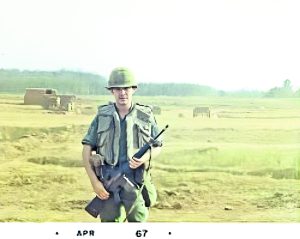
In August 1966, Jim shipped out to Vietnam: Ten days across the Pacific with 4,000 other soldiers.
After an amphibious landing, helicopters ferried them inland to Bien Hoa Air Base, a staging post before deployment.
“Then they took us near the front lines,” he said. “They cleared a couple of square miles of jungle, put up tents – and that was our home.
“Our first few weeks were just spent with filling up sandbags and preparing defensive positions.”

Jim said there were ‘very few’ basic amenities, and no running water – just rifles, flak jackets and helmets.
“We really had to fend for ourselves.”
Though not front-line infantry, Jim’s unit patrolled jungle terrain and endured indirect fire.
“Thankfully we were never in direct contact with the enemy, but we did have indirect fire coming in,” he said.
“That’s when you’d jump into your trenches with the sandbags and some of our guys might have fired a few shots into the dense jungle surrounding our camp.”
The rest of the time was spent surviving boredom, heat and scarcity.
“We were always scheming. Chicken, food, a few beers… anything to get by!”
Despite being in a warzone thousands of miles from Omagh, Jim stayed in touch with his family throughout his time in Vietnam.
“I never told my mother I was going to Vietnam,” he said. “I had written to some of my siblings about being drafted and eventually the word got back to her. I just didn’t want to worry her.
“I could imagine her watching the TV or listening to the radio, hearing about what was going on and thinking I was right in the brunt of it.”
After nine months in the sweltering jungle, his two-year service ended and Jim was sent back to the United States.
But one small detail from that period remains immortalised in the Ulster Herald archives.
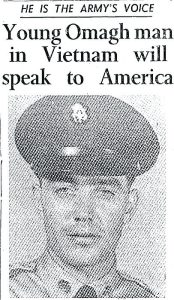
In November 1966, we published a short article informing readers that the Omagh man had been chosen to deliver a Christmas message on US television and radio to families of troops serving in Vietnam.
The article also stated that then aged 24, and the eldest son of James and Mrs McBride of 17 Abbey Street, Jim had emigrated to America two and a half years earlier, joined the New York Electric Company – Con Edison, and was drafted into the US Army 18 months before the broadcast.
Jim’s own memory of the moment is hazy.
“Oh yeah, yeah I did it alright,” he said, “but I remember very little of it. I have no idea why I was selected. It was my sister who sent it into the paper and made a big fuss about it. But when you have ‘Nam looming over you, it was hardly the biggest issue!”