



 By
By 
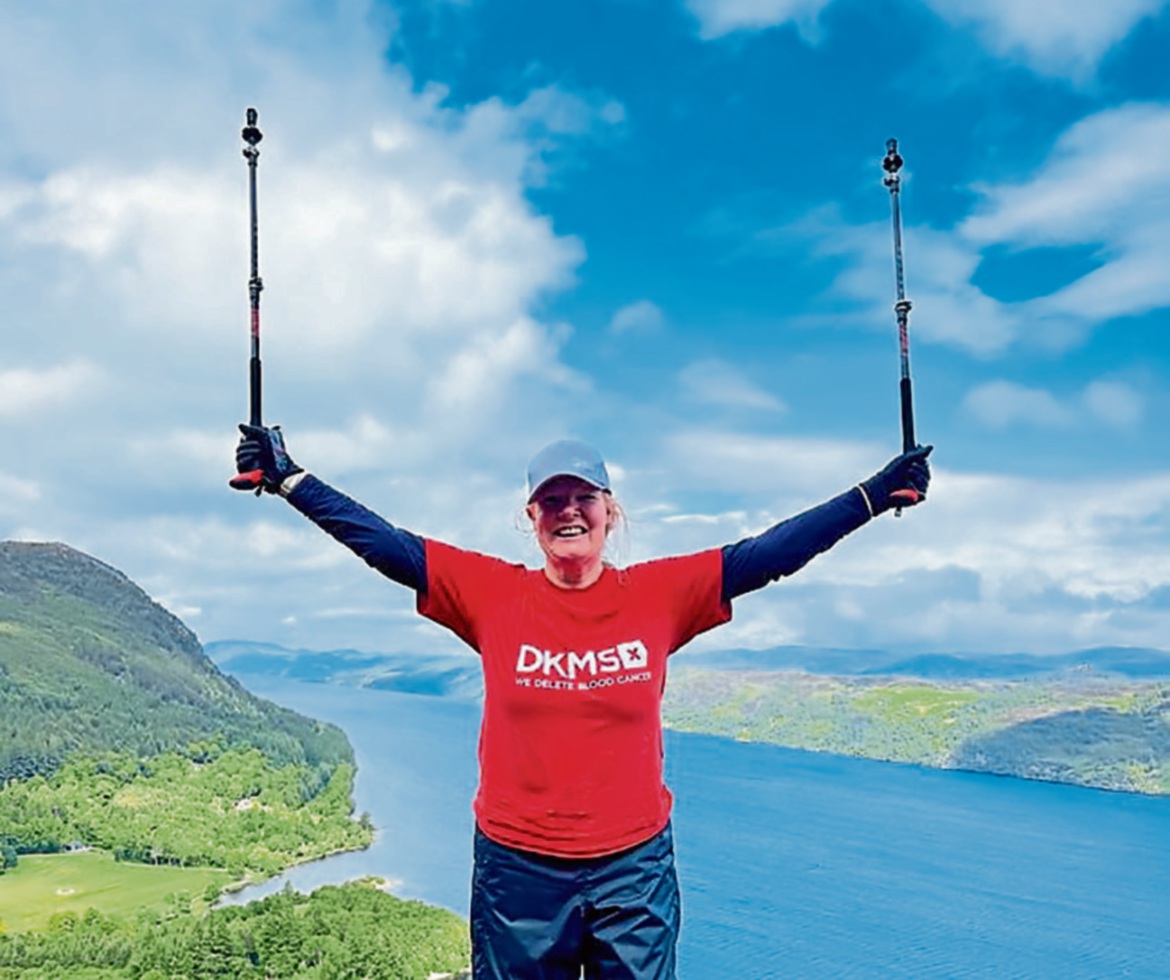
STANDING at the top of Ben Nevis five years into her cancer remission, Lesley Calder finally allowed herself what she curiously called ‘a small moment of emotion’.
The day she was due to climb Britain’s highest peak, the forecast did not look good – but unpleasant predictions were nothing new to Lesley, who when diagnosed with an aggressive form of blood cancer at the age of 54 was given a 30 to 40 per-cent chance of surviving five or more years. And on the day of her climb – June 30, 2025 – she was already a month into Year Five.
It had rained hard on Fort William’s famous peak on June 29, the day before her ascent.
And on July 1, the day after, the weather that prevailed at the summit of the Scottish giant was much the same.
“Hideous,” in Lesley’s words.
But as fate would have it, when Lesley – an Omagh woman who has been living in Hertfordshire for a few decades – awoke on the morning of her climb and made her way to the foot of the mountain, the conditions were auspiciously kind: The rain had relented, the clouds had parted and the sun had broken through.
Not a religious person, Lesley did not fall to her knees and thank God. Nevertheless, she was unable to shake the feeling that whatever was going on was happening for a reason.
In her words: “I knew I was on the right path.”
Before moving to England for university and making her life there, Lesley, the daughter of Harold and Katharine Wilson, grew up in the townland of Correnary and was a pupil at Omagh Academy.
If her parents’ names sound familiar but you do not know why, two words: Carlisle Bookshop.
Lesley left Omagh in the 1980s and life was going good.
In July 2019, her husband took early retirement and the pair were about to embark on a new chapter of their life – but not the one they had imagined.
“On August 5, 2019, I was diagnosed with acute myeloid leukaemia, and all our plans were taken away,” recalled Lesley.
“The doctors said I had an aggressive blood cancer and might only have weeks to live – which is never great to hear,” said Lesley, with a grim but jolly gallows humour.
Lesley was immediately blue-lit and sent for a battery of tests, which revealed she had a genetic profile that meant traditional treatments alone would be incapable of curing her.
“Essentially they discovered that radiotherapy and chemotherapy alone would not work. I would require a stem cell transplant, which meant we had to find a willing donor who was a genetic match. I’m one of four children, so my three siblings all agreed that they would get tested.”
In general terms, the chances of any two sibling having completely compatible types of bone marrow are about one in four – which is why 70 per-cent of people who require a transplant have to rely on a stranger for donation.
So when it turned out samples collected from two of Lesley’s siblings came back from the laboratory as full matches, and the other showed up as a half-match, the doctors were delighted.
“My story is full of mathematical improbabilities, and that’s one of them. After more tests, it was found that my sister Ann – the second oldest after me – was the most suitable candidate for a transplant.”
But before the transplant could be performed, Lesley had to undergo two bouts of intense chemotherapy to reduce the number of ‘blasts’ in her bone marrow.
“Blasts are immature, abnormal blood cells that multiply uncontrollably in the bone marrow and crowd out red cells, platelets and mature white cells,” said Lesley.
“After my first bout of chemo, the count was only down to 63 per-cent. Thankfully, after the second bout, which was much more intense, that fell to three per-cent, which was low enough to allow them to go through with the transplant. But not before another few issues came up.”
Each warp and weft of Lesley’s health journey cannot be detailed, purely because the set-backs, breakthroughs and seemingly defining junctures number too many to detail.
Suffice to say, on December 18, Lesley sat with her sister Ann as doctors filtered stem cells from her bloodstream.
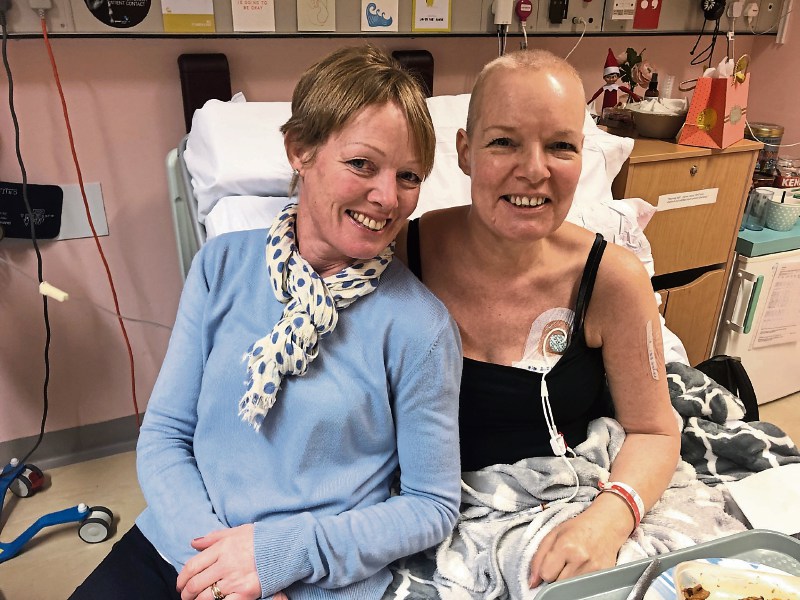
Later that day, Ann held Lesley’s hand as her DNA became part of her sister’s.
Reflecting on this, Lesley said: “We were always close, but this created a new bond. The DNA in my immune system and blood are almost 100 per-cent Ann’s.”
After a short laugh, Lesley said, “I could probably commit a crime and have it pinned on Ann.”
It took Lesley a couple of years before her immune system, which the treatment essentially destroyed and then rebuilt from scratch, to reach the standard of a normal healthy adult’s.
“I had to get all my baby injections again and everything,” said Lesley.
But when she regained her health, she began giving back.
“When Tracey McKenna (a teacher from Fintona who was diagnosed with leukaemia in 2024), I asked DKMS (international charity fighting blood cancer by recruiting blood stem cell donors) if I could be part of the recruitment drive, and they said yes.”
Lesley came home and went into local schools to spread the message of how anybody can become a potential lifesaver by getting a few tests done and getting on the international stem cell donor register.
In addition, she also set up and now runs a volunteer hub for DKMS that runs registration drives and fundraisers across Hertfordshire and Essex, as well as Cambridgeshire and Suffolk.
“I’m so proud of the team of over 20 volunteers of friends, donors and people who’ve undergone transplants that I’ve put together.
“And I’m so grateful to be fit and healthy enough to have done it.”
Because Lesley’s story is one that is still in progress, there is no proper place to end.
But this next detail, which may be the most unlikely of all the statistical oddities in Lesley’s entire underdog tale, seems like as good of a place as any to finish.
“After seeing what I went through, my son Max joined the register in 2022 or 2023,” said Lesley.
“Once you’re on the database, the odds of ever actualluy getting called as a potential match are about one in 800 – but, low and behold, along with three others, Max did.”
After going through follow-up tests, it was established that Max, if willing, would be the prime candidate.
“The person Max donated to is from America, and all we know about him is that the transplant seems to be working. If that continues, he and Max will have the chance to share their details with each other.
“If they both agree, then they’ll get to talk and maybe even meet. I don’t know if the person will, but I know Max wants to. Even though we don’t know him, we think about him everyday.
“I’m so proud of Max. It just shows what a difference joining the register can make.”
To find out more about how to register as a stem cell donor, visit ‘www.dkms.org.uk’.