




 By
By 
FOR generations of pupils, choosing a language at secondary school felt less like an adventure and more like a practical necessity.
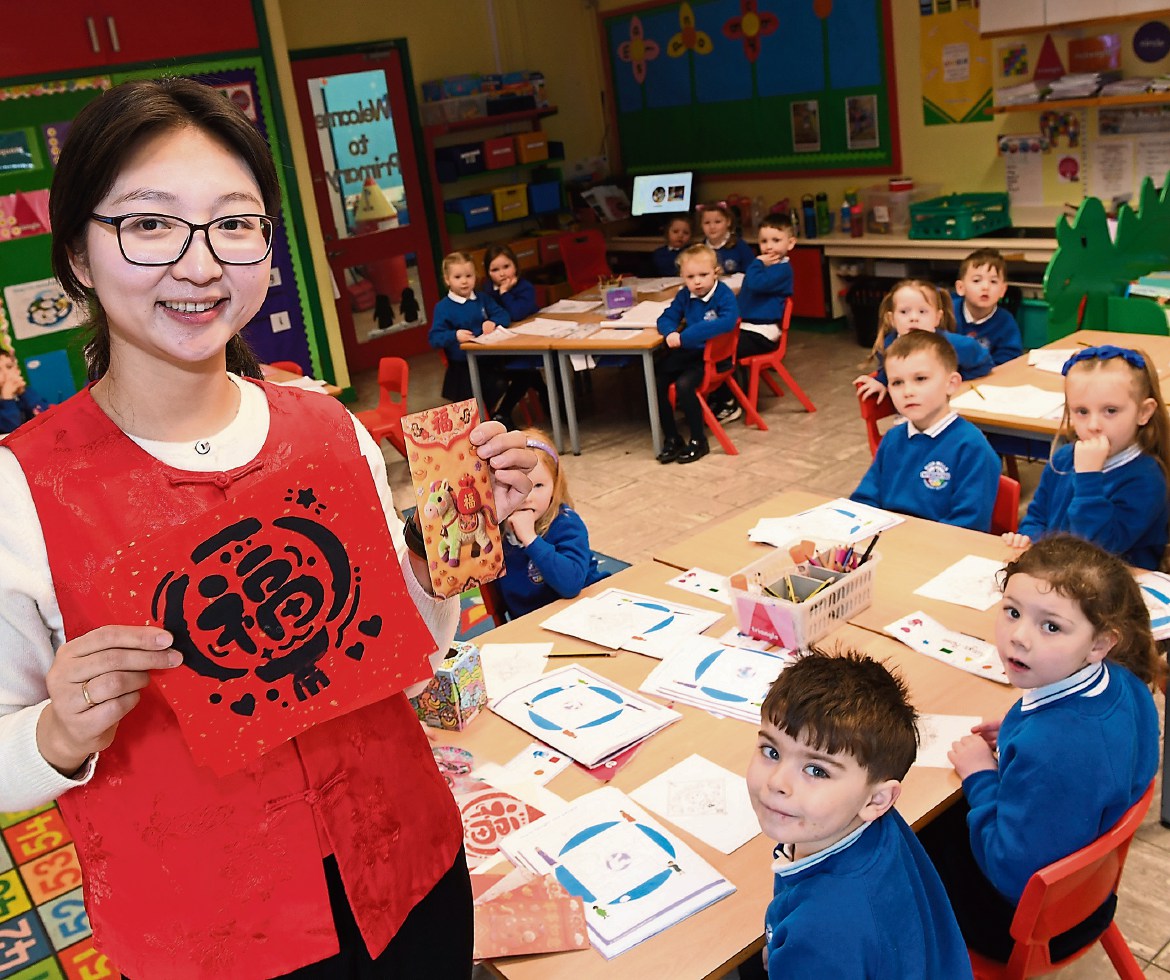
Irish for heritage, French or Spanish for holidays – that was about the size of it. Few would have imagined that, one day, young children in a quiet corner of Tyrone would be learning the tones and characters of Mandarin Chinese, opening a window not just to another country, but to an entirely different way of seeing the world. At Sion Mills Integrated Primary School, that window has been flung wide open.
Through South West College’s Confucius Hub, pupils at the school are now being introduced to Mandarin – the most widely spoken language on Earth, with around 1.3 billion speakers worldwide, over a billion of them native. It is a bold step for a small school, but one that reflects a changing world where global connections have become essential threads in the fabric of everyday life.
At the heart of this initiative is Cai Liexu, a Mandarin teacher whose journey from mainland China to Northern Ireland spans more than 5,000 miles – and a profound change in career direction.
Cai is a native of Shishou, a city of approximately 470,000 people in Hubei Province, situated beside the mighty Yangtze River. She describes her hometown as “very beautiful”, highlighting attractions such as the Tian’ezhou Elk National Nature Reserve and the historic Taoyuan town.
Although she now speaks with the ease and assurance of someone who has found her calling, teaching was not always part of Cai’s life plan.
“I originally pursued a different career, studying International Economics and Trade at university,” she explained. “However after graduating, I received an opportunity to become a voluntary teacher in the Philippines, which I did from 2012 to 2014.
“During these two years I really fell in love with teaching Chinese and working with the students. The experience really took hold and inspired me to change my career path so I went on and studied to become a teacher full time. I teach Mandarin full-time now but also have a keen interest in intercultural communication and engagement.”
It was a turning point that would ultimately lead her to Tyrone.
“I was assigned to Northern Ireland back in August of 2024 as part of a government-funded, two-year language exchange programme between the UK and China and was organised between the Confucius Institute at Ulster University and Hubei Normal University back home.
“I was assigned to the Confucius Hub in South West College in Omagh as one of 12 teachers.
“In addition to working in Sion Mills every Monday and my work at the South West College, I have a full programme of work which takes me to other schools like Omagh Academy, Loreto Grammar School, Drumragh Integrated College and St Colmcille’s Primary, so I’m always kept busy.”
It is a demanding schedule, but one Cai embraces with clear enthusiasm. Each classroom presents a different dynamic, a different age group and a different motivation for learning.
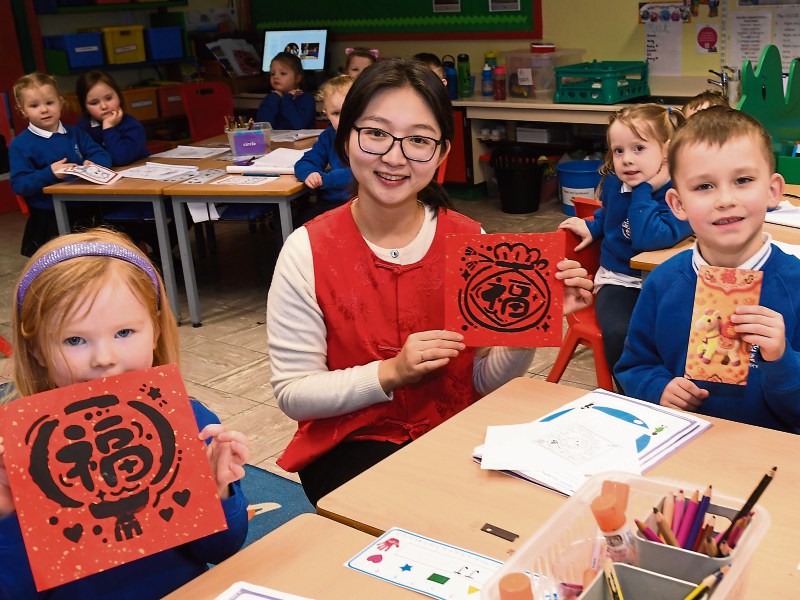
For those unfamiliar with Mandarin, the written script alone can seem daunting. It resembles a cascade of intricate characters which bears little resemblance to the Latin alphabet. To Western eyes, it can look impenetrable.
Cai gently challenges that assumption.
“Absolutely not, it’s just a different system than your used to. I describe Chinese to my students as a ‘logographic’ language while English is alphabetic, meaning you can usually sound out a word to grasp without knowing its meaning. With Chinese, the character can give clues to its meaning, even if you don’t know how it’s pronounced.
“Of course, learning any language requires dedication, passion, environment and time but once you grasp the logic behind the language and culture, you can learn it quickly.”
Her explanation reframes the challenge. Rather than being harder, Mandarin is simply structured differently. It is rooted in symbols that carry meaning within their very shape. Where English relies on phonetics, Mandarin invites learners to think visually and conceptually.
Cai is keenly aware that effective teaching means meeting students where they are. A five-year-old and a fifteen-year-old approach learns in very different ways, and adults again differently still.
She explains that children often respond with natural curiosity and playfulness, while teenagers may be influenced by pop culture – music, fashion, social media and global trends. Adults, on the other hand, tend to arrive with clearly defined goals, whether career-driven or rooted in personal ambition. Her role, she says, is to adapt.
“I think the best way to learn Chinese is to start with something you’re interested in. It could be traditional Chinese clothing, Chinese food culture, daily life in China, or Chinese cities. Using these interests, makes a wonderful starting point makes learning more engaging.”
STRENGTHS
The oft-repeated phrase that “children’s brains are like sponges” rings true in her experience, though she is careful to acknowledge the strengths of learners at every age.
“Children are generally more open to differences due to their natural curiosity, while adults often have strong self-driven motivation when they choose to learn Mandarin on their own.
“I find teaching children very enjoyable and they are always eager to learn about different languages, customs and cultures; seeing their smiles every week is one of the things which makes me happiest as a teacher.”
Those smiles, she suggests, are the true measure of success — a sign that language is not being treated as an abstract academic exercise, but as a living bridge between people.
The wider political and cultural climate may also be playing a role in Mandarin’s growing appeal. Cai points to the recent visits to China by UK Prime Minister Keir Starmer and Taoiseach Micheál Martin as potential catalysts for increased interest.
“More schools are offering it as a subject, and both young learners and adults are showing increasing interest in learning Chinese for cultural and career opportunities,” she says. “`With China opening visa-free access for UK citizens, I believe more and more people will choose to travel to China and experience the beauty of cultural similarities and differences first-hand.”
It is, perhaps, a reminder that language learning rarely exists in isolation. It is shaped by trade, and travel – and the simple human desire to connect.
As her two-year tenure in Northern Ireland draws to a close in the coming months, Cai reflects on her time in Sion Mills with warmth and gratitude.
“The students are always happy to see me, and I’ve found the teachers, the kitchen and gardening staff, all very helpful. I feel very lucky to have built such a strong connection with the school over the past two years. People are very friendly, the surroundings are peaceful, and the nature is so different from back home. I will miss it terribly.”