



 By
By 
A recent memorial service has revived interest in Father Patrick Hughes, a priest remembered not for high office or public prominence, but for cures attributed to him, books written about his life, and a memory that has endured for generations. It has led many to ask how a rural priest, serving quietly in Tyrone and Armagh, came to be so widely known and long remembered. The following account is compiled from an Ulster Herald article published in 1971.
An Altamuskin priest who was born in the decade of the Great Famine and who, after serving in two parishes in the Armagh Archdiocese retired to spend his last years in his native district, had the unusual tribute of having his biography written during his lifetime.
It was, in fact, almost unique that the life story of a rural priest should have been written at all. There are not many similar instances to be found in Ulster.
But Fr Patrick Hughes was no ordinary person, which perhaps accounts for two books being written about him during his lifetime.
He occupied no great post in the Archdiocese nor was he distinguished by achievement in any special field. His sole claim to remembrance was among the people whom he served with endless devotion and solicitude and who recognised that in him they had an outstanding pastor.
The 46 years of his active sacerdotal work were divided between the parishes of Loughgall and Eglish, in both of which districts he is today almost a legend for the manner in which he completely identified himself with his people’s interests.
A booklet was published by Messrs Browne and Nolan of Dublin early in 1920 and there are very few copies existing today, save perhaps, in the homes in Altamuskin where the memory of Fr Hughes is exceptionally treasured.
The author was Charles J Kelly of Killaghy, Omagh, who in a foreword states that much of his material was borrowed from an earlier sketch by Fr Boyle but whose work was no longer obtainable. Are there any copies of this earlier work? There must surely be some Mid-Tyrone household where Fr Boyle’s memoir of Fr Patrick Hughes has been preserved.
C J Kelly’s little work is in places pietistic – perhaps too much so – but it is a very interesting account, and readable too, of one of the best loved Ulster priests of his day.
In time of the Famine
Fr Patrick Hughes was born in Dumnoyle on March 22, 1846, just two years before the worst of the Famine period afflicted Ireland. His parents were ordinary country people enduring with their neighbours the rigors of that terrible period, and the Hughes family, a bit better circumstanced than many others, were noted for their charity and benevolence.
The entire country was less than two decades distant from Catholic Emancipation and in many rural areas there were just the simplest of church buildings, and often merely a shed provided the covering for the celebrant at Mass.
Fr Hughes was baptised at the Mass-house in Altamuskin, about a mile ‘as the crow flies’, from his own home. Kelly records that ‘the spot where the ceremony took place can still be pointed out. It is a small green plot in a sheltered corner beside Altamuskin Bridge, a few hundred yards from the Post Office on the Ballygawley side.’
‘A country school’
The future priest was the fourth of a family of six, and his mother Margaret was, so the priest afterwards delighted to claim, one of the great Clan O’Brien who fought at Clontarf and who were Chieftains of Thomond.
Fr Hughes’s first schooling was in a small hut near his own home, and the crude building, dignified with the style of National School, had upwards of 100 children. Fr Hughes recalled that the teacher had a hard time keeping order among his boisterous charges, and had little time left for instruction. “The rod of correction was out every morning by the first culprit, and a leather thong was always kept in reserve.”
In these unpromising surroundings young Patrick stood out as an ideal pupil and in due course was selected by the local clergyman after an examination conducted subsequent to the holding of a Station in one of the neighbouring houses – to study at a local ‘hedge school’.
One of the hedge schoolmasters
Master John Murphy was the pedagogue and like many another who laboured in humble spheres in those times he was exceptionally talented. As a teacher of languages he was not only competent but possessed the capacity to inspire his pupils with his own enthusiasm.
There was no ‘rod’ in the little wayside academy where Patrick now studied. When he left the ‘hedge school’ after three years he was well learned in Latin and Greek and was equipped also with a fairly advanced course in Euclid and Algebra.
His next school was the Diocesan Seminary at Armagh, then labouring under the economic difficulties that affected the entire country. There was little money to spare to run such an establishment, and the pupils led a rigorous life. The food was bad, Fr Hughes later recalled, and, worse, it was also scarce: “The buildings were defective and the accommodation limited” and its inmates regarded it as a place “where some souls suffered a sort of purgatory before passing to Maynooth.”
Appointed CC, Loughgall
Three more years passed and young Patrick Hughes left the Seminary for Maynooth where, he used to say, he could scarcely credit the happy change in his circumstances.
He completed his course there – in the vacation periods travelling as much as his limited means could afford – and was ordained in Dundalk early in 1872, ahead of his time. He had been a leading student and a favourite with all.
A short holiday at home preceded his first appointment, as curate in the parish of Loughgall where he won all hearts. He had no parochial residence and was obliged to board with parishioners but during his years in the parish he provided schools and a church and also a house for the priests.
Everyone knew him and he was, in his old age, as friendly with those of other creeds as he was with his Catholic flock.
Primate McGettigan
Although only a young curate he rejoiced in the personal friendship of the Primate, Archbishop McGettigan who had come from Donegal to succeed to Armagh – an appointment to which he had been named when he was attending the First Vatican Council.
The Primate was deeply interested in the energetic, exceptional young priest and seeing his happiness in Loughgall and the great work he was doing did not transfer him after years – as was customary then.
Having been curate in Loughgall for 20 years, Fr Hughes might have been excused for thinking that it was the intention to leave him there for good, but in the following year he was asked by Cardinal Logue to go as PP to Eglish in South Tyrone.
He wished at first to decline this, but felt in the end that he must accede to the Primate’s wish.
His departure from Loughgall was a momentous event. On his journey to Eglish he was accompanied by all of the parish.
Kelly records that ‘even Orange Lodges of that strongly loyalist area, resolutions of sorrow at the departure of Father Hughes were passed’.
Friend of the vagrants
In the parish of Eglish Fr Hughes repeated the success he had made of his long term in Loughgall. As before, he attended to all the needs of his flock and set them an example in all matters.
He was a prudent and progressive administrator of his parish. He never allowed a penny of debt to accumulate on it and he built the finest parochial school of its day in the entire Archdiocese.
A week’s holidays was all that he would permit himself, preferring to spend every moment visiting his people or, more usually, doing host to them at his own residence.
Half-a-crown was his usual disbursement to any vagrant who besought his aid and he paid dearly for this in every sense of the term – the vagrants spread the good news and the kindly priest was never done putting his hand into his pocket.
Those he helped spoke not only of spiritual and emotional consolation, but also of physical cures. Fr Hughes himself made no claims in this regard, and those who knew him described him as modest and reserved, directing attention instead to faith and prayer.
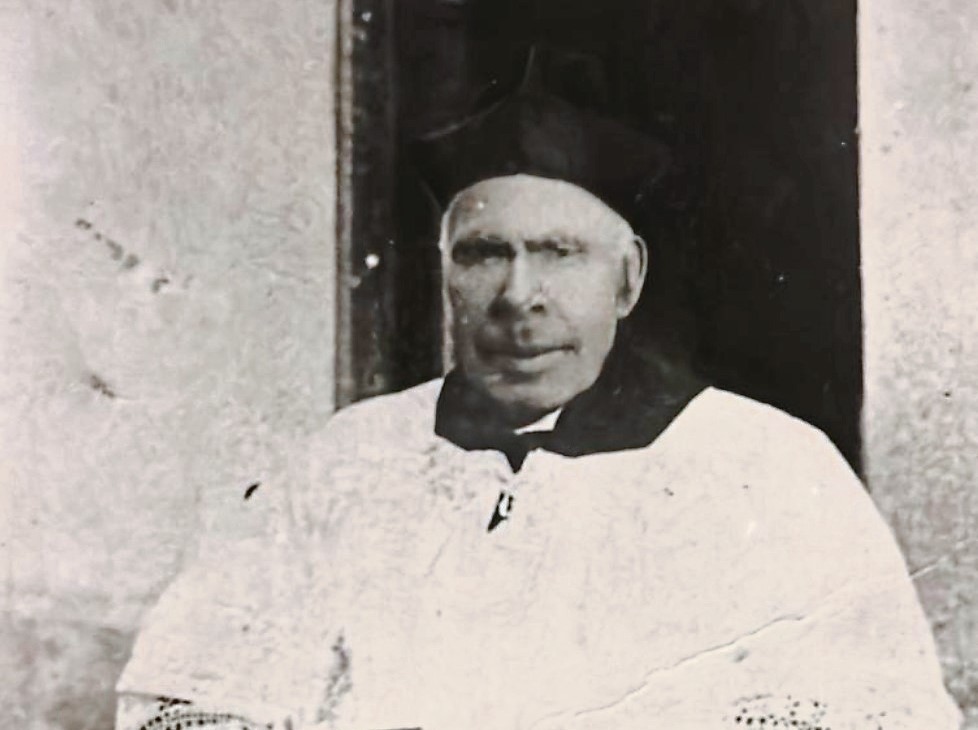
Stories of cures spread widely and were passed from family to family. Even after his death, it was claimed that cures were effected simply by touching his surplice. Until comparatively recent decades, it was also common to see his photograph displayed in homes throughout the district, treated with a reverence usually reserved for sacred images.
Another long-standing tradition associated with Fr Hughes concerned his grave. It became customary for people to take a small handful of soil from it for cures, on the understanding that an equal amount of soil from their own locality should be left in its place. This practice was carried out quietly and with care, and was spoken of with respect.
Active interest in politics
His period as pastor of Eglish covered the years of William O’Brien’s United Ireland Party, the Great War and the Lloyd George attempts to find common ground between Carson and Redmond.
Fr Hughes was an ardent O’Brienite. Was there a touch of his pride in calling himself an O’Brien on his mother’s side? He opposed Redmond and the Irish Party, and Kelly’s booklet makes him scathing in his denunciation of the St Mary’s Hall Convention in Belfast in 1916 that accepted partition even on a conditional basis; the British partition the North.
He was ill in bed when news reached him of the Devlin pact to recommend the Lloyd George scheme. But he delayed not. Fr Hughes ‘dragged himself to take his stand by [his people] and raise his voice against the betrayers of his country’.
Memorable speech
at Convention
Some excellent speeches were made that day by the men of Derry, Tyrone and Fermanagh and it is a pity that a complete record does not exist of the proceedings in St Mary’s Hall.
Father Hughes’ speech was in line with those who [rejected] proposal for partition, temporary or not.
“What!” he exclaimed “are we going to hand the graves of Patrick, Brigid and Colmcille into the care of a foreign government?” And that, so far as he was concerned, was final.
He took a great interest in international as well as domestic politics, and so much for his shrewdness that in 1919 when [people were] proclaiming that Germany was down, never to rise again, Hughes declared that “Germany is not sleeping, and will come again and smite her enemies with a vengeance more terrible than that which has fallen to her.”
Resigned his parish
But as the weight of years pressed him down Fr Hughes found that he had to be off parochial duty for increasingly long periods. Disliking this, and feeling that his flock was in danger of being neglected, he decided to resign his pastoral charge and go into retirement.
It was indeed a hard step to take, to break many friendships and to retire from the scene on which he had played so prominent a part. He had been PP in Eglish for years and the parish grieved when it learned that he proposed to lay down the pastoral staff.
The people prepared addresses and other testimonials of their regard and to do him honour, but he divined their purpose and fled the parish in secret, as St Pius X had fled his parish to avoid public [honour].
The return to Altamuskin
For his new home Father Hughes turned his thoughts to his native place and came to live in the house of his kinsman, James Shields of Altamuskin.
There for the remainder of his life he enjoyed a retirement he had earned so well.
Kelly records that motor-cars and every conveyance lined the road and filled the fields around the house as people came to see the humble priest who had made it his aim to hear their woes and to give them aid and consolation.
He is buried in the churchyard at Dumnoyle among his own people, in the area he loved.