





 By
By 
Ask any parent or guardian who knows their child best and almost universally they’ll tell you the same thing: Nobody understands their little angel like they do.
But as anyone who’s ever met the mediocre son after hearing the mother’s glittering introductory profile of him knows, this is absolute rubbish.
When it comes to what little Benny or Brigid are really like, mum and dad, generally speaking, are deeply, helplessly and hopelessly deluded.
I think the polite word for the condition is love.
And this love has no statute of limitations; there is no expiration date to the transfiguring fondness a parent feels for their child.
Not a bit of it.
The same warped perception that makes the baby boy resemble a cherub rather than a pink, wrinkly potato will one day, in the eyes of his mother, transform the catatonically lazy teenager into a growing cub who needs his rest.
When he finds himself in a bit of bother, stealing or fighting, he’ll not be a miscreant like the neighbour’s son, but instead a lovable rogue.
And when he gets himself a girlfriend, depending on the mother’s disposition and the specifics of her delusion, the lucky young lady will, like the son, either glow like the Lord upon Mount Tabor or be deemed an unfit partner for someone of His Highness’s exalted station.
And despite temporary lapses of love along the way, usually induced by incidents of outstanding stupidity, dishonesty or malevolence, during which reality is briefly revealed to the parent, this mirage will be maintained.
Yes, the love that makes one’s progeny appear smarter, better-looking and generally much more brilliant than they actually are seems to be a lifelong condition: congenital, chronic and – luckily -completely non-contagious.
If questioned, most parents would probably say their love for their children is self-evident. They’d argue that asking why you love your children is as nonsensical as asking why you want to take your next breath.
But I, a non parent, can’t be sure.
Freud – who, it should be noted, also gave us the Oedipal complex (kill yer da, romance with yer ma, etc) – had another interesting, less incestuous theory about parents and their children.
He reckoned that parental love isn’t some pure, unilateral, unconditional supernatural force. Rather, he thought, parents see their children as extensions of themselves: vehicles through which they can live vicariously, vessels into which they pour their hopes and dreams.
Maybe so.
Or maybe it’s more Darwinian than that. Perhaps it’s about propagating genes, protecting the bloodline and ensuring the survival of the species.
Like I said, I’m not a parent. You can tell at a glance. I’m happy, unstressed, well-slept and free.
All I know is that my parents bought me a £25 copy of James Joyce’s ‘Ulysses’ for Christmas this year, and that planted in my head the idea for this column – that parents inevitably overestimate their children just as children tend to, at some point, undervalue their parents.
I’d always known this was a thing, but when I removed the wrapping paper from my book-spared gift on Christmas Morning and saw the embroidered lettering – ‘U-L-Y-S-S-E-S’ – I realised this phenomenon, the parental love delusion, is still part of my life.
Then, when I told my ma and da I would never be fit to understand the book and they, as though reassuring Einstein that the physics will be no bother to him, told me to just read it in wee bit at a time (as opposed to all in one?!), I realised just how acute their condition remains.
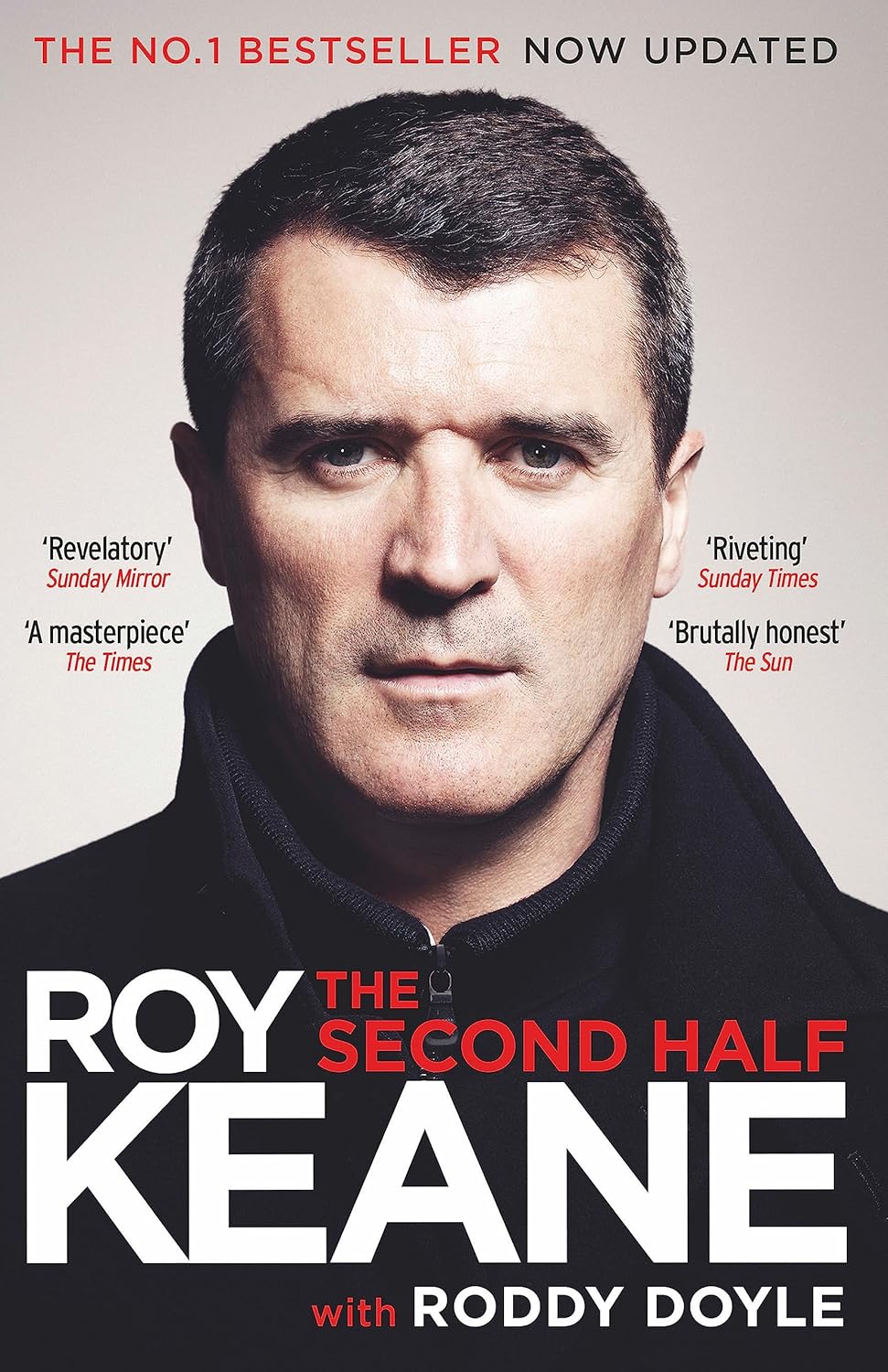
Maybe when my da notices that my mother’s gift to him – Roy Keane’s ‘The Second Half’ – has gone missing, he’ll realise that I’m not all they think I’m cracked up to be.
Either that or they’ll start to believe Keano is the next Joyce.